FTSE Finish Line: June 26 — Tech Tremors, Oil Retreat and Burnham Watch Cool the Rally
FTSE Finish Line: June 26 — Tech Tremors, Oil Retreat and Burnham Watch Cool the Rally
London drifted lower on Friday as the FTSE 100 gave back some of its recent gains, hit by a global technology sell-off, weaker oil prices and renewed caution around the Middle East despite easing supply concerns. The tone was defensive rather than panicked, but the leadership that powered the index earlier in the week faded as investors moved back toward staples and lower-beta names. Energy was the main drag. BP fell nearly 2% and Shell dropped more than 1%, tracking a roughly 2% slide in crude prices as shipping through the Strait of Hormuz resumed and supply fears eased. Brent and WTI crude moved back toward levels last seen in late February, undercutting the sector’s earnings momentum and removing one of the FTSE’s key supports. The move was complicated by fresh geopolitical risk after a container ship was attacked near the coast of Oman, forcing a pause in evacuations of stranded seafarers. Normally that type of headline would support oil, shipping-risk premia and energy equities. Today it did not. The market’s reaction suggests investors are treating the incident as a security risk rather than a durable supply shock, at least for now.
Mining and materials were also under pressure. A stronger dollar, driven by global uncertainty around technology shares and inflation concerns, weighed on base and precious metals. BHP fell more than 1% after announcing executive leadership updates, while mining sectors lost more than 1%. Chemical stocks were the weakest group, falling around 2.8%, as cyclical and commodity-sensitive exposures were marked down. The technology sell-off was the broader global backdrop. Even though the FTSE 100 has limited direct tech exposure, it is not immune to a global de-risking episode. When investors reassess long-duration growth, AI positioning and inflation risk, the spillover usually hits cyclicals, miners, industrials and emerging-market-sensitive financials. That pressure kept London on the back foot. Defensives worked. British American Tobacco rallied about 2% after announcing plans to launch another share buyback programme during the closed period ahead of its July 30 half-year results. Food, beverage and tobacco stocks gained around 1%, while personal goods also edged higher. The rotation showed investors were not abandoning UK equities, but they were reducing economic sensitivity.
Outside the FTSE 100, Wise jumped 7.6% after saying active customers rose 21% to 18.9 million in fiscal 2026 and announcing plans for a new share purchase programme. The update stood out in a weaker tape, with the market rewarding growth, customer momentum and capital return discipline. Travel and leisure remained under pressure from the conflict backdrop. Heathrow Airport lowered its 2026 passenger forecast and warned that profit could shrink this year, highlighting how geopolitical instability can still feed directly into demand, routing, costs and passenger confidence even when headline oil prices fall.
Politics remained a key domestic overlay. With no serious rival yet in the frame, Andy Burnham appears likely to be “coronated” as prime minister in July after Keir Starmer’s resignation earlier this week. Sterling markets have largely absorbed the political shock, but investors are still waiting for the two details that matter most: who becomes Chancellor and how fiscal policy is reframed. Burnham is expected to emphasise growth, infrastructure and policy devolution while remaining inside the existing fiscal rules. That sounds reassuring on paper, but markets will stay sensitive to the difference between rule compliance and actual gilt supply. As discussed through the week, a government can stay within the rules while still increasing borrowing for investment through accounting flexibility and institutional design. For gilt investors, that distinction matters. There was some relief in rates. UK 10-year gilt yields closed below 4.70% for the first time since March, although they remain volatile. That helped prevent a deeper sell-off in domestic equities, but it did not produce a strong risk rally because investors are still pricing at least one 25bp Bank of England rate hike this year, according to LSEG-compiled data. That is the policy tension facing the market: growth data are soft, retail activity is weak, and domestic cyclicals remain fragile — but inflation expectations and geopolitical risks keep the BoE cautious. Investors are now focused on whether second-round inflation effects emerge from the recent conflict shock, particularly through credit conditions, pricing plans and wage expectations.
Next week brings a heavy UK data calendar. Monday delivers money and credit figures, Tuesday brings the Lloyds Business Barometer and final Q1 GDP, midweek brings final PMIs, Thursday brings the BoE credit conditions survey, and Friday delivers the Decision Makers Panel. For the BoE, the key questions are whether credit has tightened because of recent global stress and whether inflation expectations have moved higher after last month’s sharp increase. The weekly picture is still constructive for the FTSE 100. The internationally exposed index remains on track for its biggest weekly gain in more than a month as Middle East tensions ease. But the more domestically exposed FTSE 250 is heading for small weekly losses, reflecting persistent pressure from gilt yields, political uncertainty and weak consumer data.
Finish Line: The FTSE 100 slipped on Friday as global tech weakness, lower crude prices and a stronger dollar weighed on energy, miners and chemicals. Defensives outperformed, with BAT lifted by buyback plans and Wise surging on customer growth and a new purchase programme. The index’s weekly gain remains intact, but the market is moving into next week with caution: Burnham’s likely coronation may steady politics, yet gilts, inflation expectations and BoE hike pricing remain the real tests.
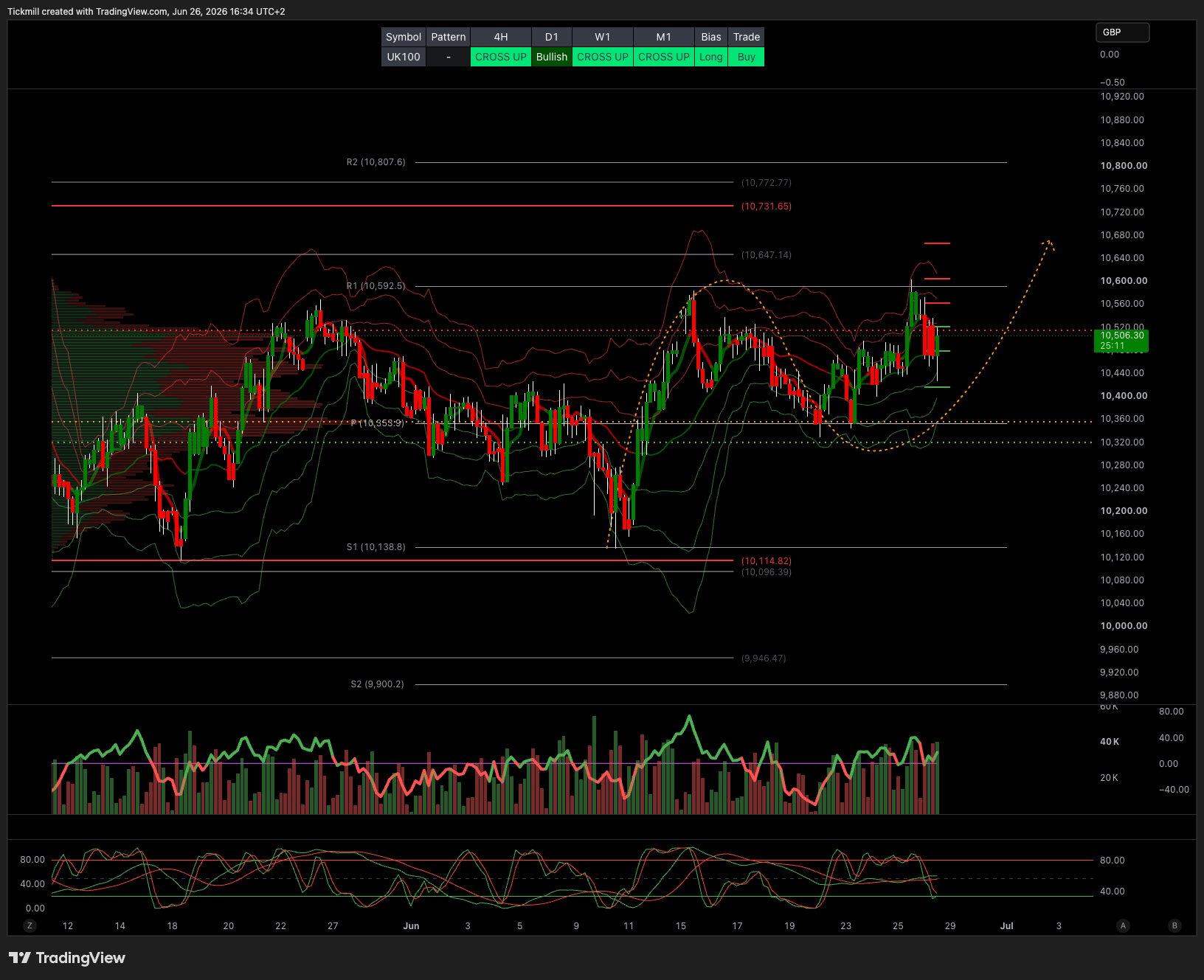
TECHNICAL & TRADE VIEW – FTSE100
Daily VWAP Bullish
Weekly VWAP Bearish>Bullish
Above 10350 Target 11000
Below 10100 Target 9469
Disclaimer: The material provided is for information purposes only and should not be considered as investment advice. The views, information, or opinions expressed in the text belong solely to the author, and not to the author’s employer, organization, committee or other group or individual or company.
Past performance is not indicative of future results.
High Risk Warning: CFDs are complex instruments and come with a high risk of losing money rapidly due to leverage. 69% and 73% of retail investor accounts lose money when trading CFDs with Tickmill UK Ltd and Tickmill Europe Ltd respectively. You should consider whether you understand how CFDs work and whether you can afford to take the high risk of losing your money.
Futures and Options: Trading futures and options on margin carries a high degree of risk and may result in losses exceeding your initial investment. These products are not suitable for all investors. Ensure you fully understand the risks and take appropriate care to manage your risk.
Patrick has been involved in the financial markets for well over a decade as a self-educated professional trader and money manager. Flitting between the roles of market commentator, analyst and mentor, Patrick has improved the technical skills and psychological stance of literally hundreds of traders – coaching them to become savvy market operators!